Design Subscription vs. Freelancers vs. In-House: What Makes Sense for D2C Brands?
Compare graphic design subscriptions, freelancers, in-house designers, and agencies for D2C brands. Discover the differences in cost, turnaround time, scalability, and creative output to choose the right design model for your business. Cover Image Alt Text
Direct-to-consumer (D2C) brands live and die by their creative output. Scaling customer acquisition requires a relentless pipeline of high-converting Meta and TikTok ad variants, polished packaging dielines, Shopify banners, and thumb-stopping organic social assets.
How do you scale visual production without burning out internal resources or blowing through your marketing budget? When creative volume spikes, founders and marketing heads inevitably hit this critical bottleneck.
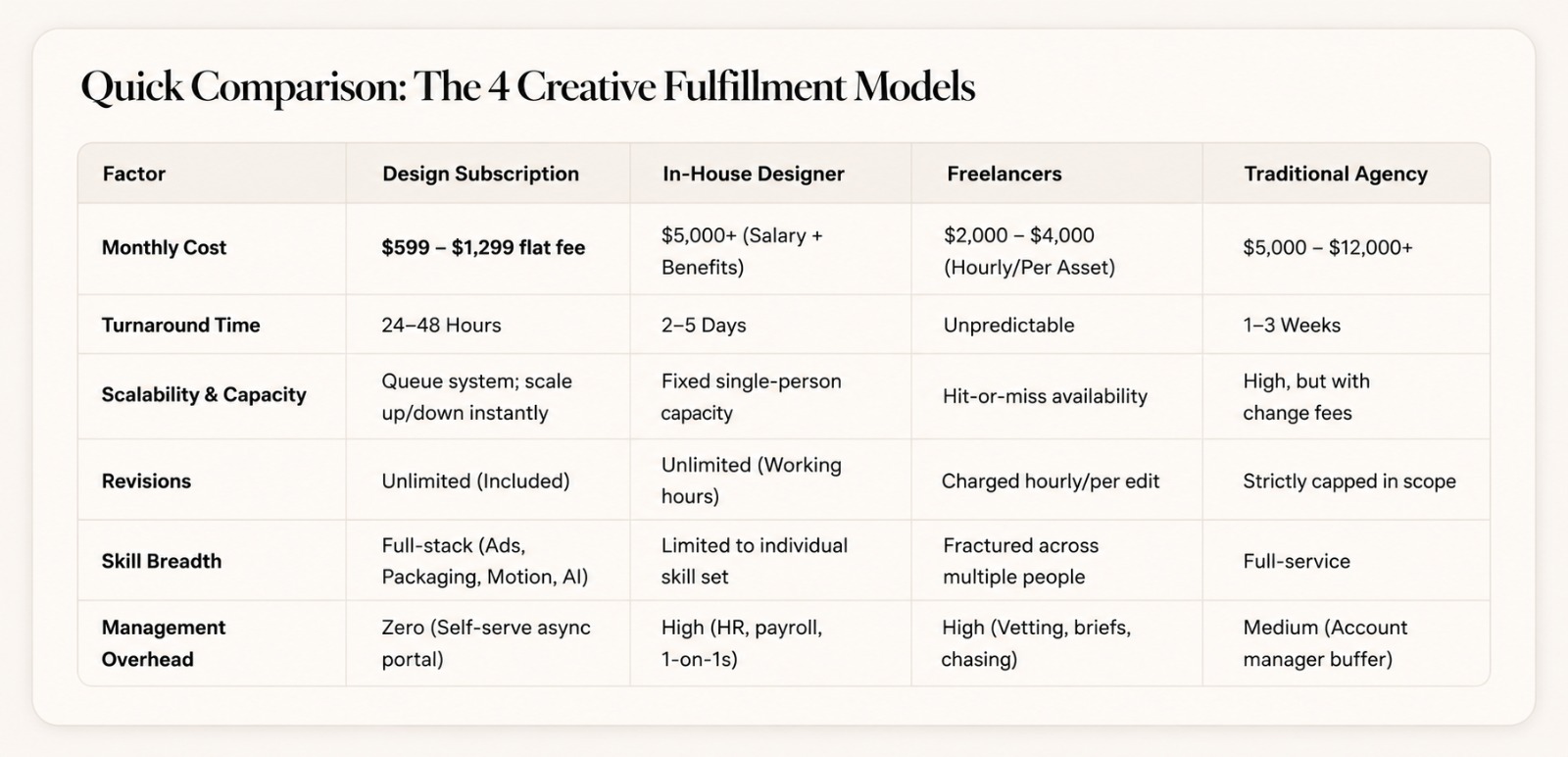
To solve this, brands generally choose between four fulfillment models: hiring an in-house designer, juggling marketplace freelancers, partnering with a traditional creative agency, or using an unlimited graphic design subscription. Here is an honest, data-backed comparison to help you determine which model fits your brand's growth stage and budget.
1. The In-House Designer: Deep Focus with High Overhead
Hiring a full-time, in-house designer is the traditional benchmark for established brands. You get a dedicated team member who lives and breathes your brand guidelines 40 hours a week.
The Upside:
· Total Brand Immersion: An in-house designer understands your company culture, tone, and long-term vision intimately.
· Immediate Availability: Real-time collaboration in Slack for urgent asset changes or live product launches.
The Downside:
· Excessive Cost: In key markets (US, UK, CA, AUS), hiring an experienced brand or performance designer costs between $65,000 to $95,000 annually before factoring in payroll taxes, software licenses (Adobe Creative Cloud, Figma), healthcare, and hardware.
· Skill Bottlenecks: A single designer is rarely a master of everything. A great packaging designer might struggle with high-converting motion ad editing or 3D/AI product rendering.
· Rigid Overhead: When ad spend drops or seasonality hits, you cannot pause a full-time salary.
2. Freelancers: Flexible but Fragmented
Using platforms like Upwork or Fiverr is often the first step for early-stage D2C founders looking to get quick, one-off deliverables done affordably.
The Upside:
· Low Initial Barrier: Easy to hire for single, isolated tasks like a one-time logo refresh or an individual packaging dieline.
· Specialized Talent Pools: You can find distinct specialists for specific niches (e.g., 3D blender artists or Shopify UX designers).
The Downside:
· The 'Freelancer Roulette': Reliability is inconsistent. Freelancers take on multiple clients, go on unexpected leave, or miss critical launch deadlines.
· Inconsistent Visuals: Managing three different freelancers for social ads, print packaging, and landing page assets leads to disjointed color palettes, typography drift, and a diluted brand identity.
· High Management Friction: You spend hours writing individual briefs, negotiating hourly rates, reviewing scope limits, and managing invoicing across multiple contractors.
3. Traditional Creative Agencies: High Polish at Enterprise Prices
Agencies offer full-service strategy, creative direction, and campaign execution for enterprise brands with multi-million-dollar budgets.
The Upside:
· Strategic Muscle: Top-tier agencies bring multi-disciplinary teams including creative directors, copywriters, and performance marketers.
· Turnkey Production: Ideal for massive 360-degree brand launches and multi-channel TV/OOH rollouts.
The Downside:
· Astronomical Pricing: Standard agency retainers start at $6,000 to $15,000+ per month, making them cost-prohibitive for growing direct-to-consumer businesses.
· Bureaucratic Speed: Simple ad refreshes or minor copy tweaks often take 7–14 days because briefs must pass through account managers, traffic controllers, and art directors before reaching the designer.
· Rigid Scope Contracts: Lock-in contracts (typically 6–12 months) with strict revision limits and expensive out-of-scope invoices.
4. The Graphic Design Subscription: High-Velocity Creative Engine
A graphic design subscription (often called an unlimited design service) operates like software: you pay a flat monthly fee for dedicated, ongoing design output delivered through an asynchronous client portal.
· Predictable, Transparent Cost: Instead of unpredictable hourly bills, you pay a flat monthly rate (typically between $599 and $1,299/month). No surprise fees, contracts, or severance risks.
· Rapid Turnaround (24–48 Hours): Fast execution cycles let performance marketing teams test 10+ ad variations weekly to beat creative fatigue on Meta, TikTok, and Google Ads.
· Multi-Discipline Output Under One Roof: Covers brand identity, e-commerce packaging, performance static & video creatives, motion graphics/Reels, and AI-powered cinematic product visuals (via Higgsfield & Krea).
· Zero Management Friction: No interviews, onboarding, or HR overhead. Submit a brief via text, Loom, or Figma, and get drafts delivered directly into your dashboard.
· Pause Anytime Flexibility: Scale up during peak seasons and pause your subscription during quieter production months without penalty.
Which Model Is Right for Your Brand?
1. Choose an In-House Designer if: You are doing $5M+ in ARR, have an established marketing department, and need immediate real-time Slack collaboration across a dedicated 40-hour workweek.
2. Choose Freelancers if: You only need 1 or 2 isolated design tasks completed per quarter and have the time to vet and manage individual contractors.
3. Choose an Agency if: You require high-level brand consulting, media buying, PR placement, and have a minimum monthly creative budget of $10,000+.
4. Choose a Graphic Design Subscription if: You are an active D2C brand, agency, or founder needing continuous weekly assets—from ad creatives and packaging to AI product photography—delivered in 24–48 hours at a fraction of full-time hiring costs.
Neha Gangvani
Founder · Creative Director
Building brands that are clear, confident, and ready for growth.